A participant can stop using a treatment and still answer a researcher’s questions. Another person may remain enrolled while a particular measurement is unavailable. Those possibilities make the word “completed” less informative than it first appears. Before interpreting a percentage, identify the record it summarizes: assignment, contact, exposure or an observed outcome. Each answers a different question.
This guide uses a semaglutide research table as a starting point for learning that distinction. The figure contains the reported observations; the worked examples below are fictional and nonclinical. They show how to examine overlapping categories, changing denominators and assumptions about unavailable records. For a publication concerned with American-made products, a further distinction matters: evidence about a clinical study and evidence about a particular product’s origin require different supporting documents.
Reading the evidence
- Record first
- Define the recorded condition before interpreting its percentage.
Sources: Wharton 2022
- Overlap
- Two status categories need not divide people into separate groups.
Sources: Wharton 2022
- Denominator
- Name the group represented by the denominator, including any selection rule.
Sources: Wharton 2022
- Assumptions
- A calculation using assumed missing outcomes is a scenario, not a recovered observation.
Sources: Wharton 2022
- Evidence fit
- Match the supporting record to the specific claim being evaluated.
Sources: Wharton 2022
Remaining under follow-up is a different record from remaining exposed to treatment.
These margins neither identify every reason for stopping nor verify any product supply chain.
Sources: Wharton 2022
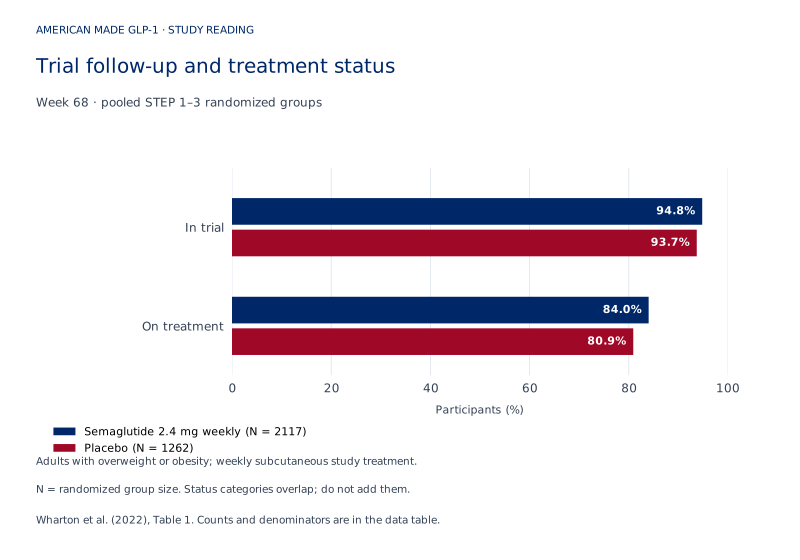
| Week-68 status | Semaglutide (N = 2117) | Placebo (N = 1262) |
|---|---|---|
| In trial | 2007 (94.8%) | 1183 (93.7%) |
| On treatment | 1779 (84.0%) | 1021 (80.9%) |
Give each status its own definition
Wharton’s post hoc analysis pooled three randomized trials of adults with overweight or obesity. Gastrointestinal events sometimes prompted permanent treatment discontinuation. Novo Nordisk funded the trials and editorial assistance; three authors were employees and shareholders. Treatment assignment was randomized, but remaining on treatment was not.
Read the figure as a set of named records. Ask what qualifies someone for each row, when that qualification is assessed and which group supplies the denominator. These questions form a data dictionary: an explanation of what each field means. A familiar word such as participation is insufficient if one reader understands it as continued contact and another understands it as continuous exposure.
The distinction also determines which information belongs alongside a result. Product, formulation, assignment and observation date are separate fields, not interchangeable descriptions. Our guide to pills and injections provides another place to organize questions about product identity. For this table, keep the printed status labels intact instead of replacing them with a broader expression such as treatment success.
Sources: Wharton 2022
Understand overlap before doing subtraction
Consider a fictional library program with 100 borrowers. At its endpoint, 90 remain reachable and 70 still use the program. These invented figures describe two conditions, not two mutually exclusive slices of a pie. A borrower could meet both conditions. Adding the percentages would count that person twice rather than reveal an additional borrower.
Suppose we additionally specify that every continuing user belongs to the reachable group. Only under that invented condition can subtraction identify 20 reachable borrowers who no longer use the program. Without the condition, the two totals alone do not tell us exactly who overlaps. The clinical figure should not silently inherit the person-level arrangement of this teaching example.
A useful reading habit is to write the missing cross-classification question in words: how many people meet both definitions? If the answer is required for a conclusion, look for that record rather than inferring it from a pair of margins. The worksheet below separates three kinds of information that could otherwise disappear into a single completion label.
| Record field | Question answered | Question still open |
|---|---|---|
| Contact status | Was contact maintained under the stated definition? | Was the outcome measured? |
| Exposure status | Was use continuing under the stated definition? | Why did use continue or stop? |
| Outcome record | Was the specified measurement available? | How should unavailable measurements be handled? |
Sources: Wharton 2022
A denominator can change the question
Imagine a separate, fictional course that begins with 100 learners. The final assessment is observed for 60, and 48 of those assessments meet a predefined standard. Dividing 48 by 60 gives 80% among observed assessments. Dividing 48 by the original 100 gives 48%. Both calculations are arithmetically correct; they describe different quantities.
The second fraction is the share of the original group known to have met the standard. It is not the fully observed success rate for the entire group, because the other 40 assessments are unavailable. Calling every unavailable assessment unsuccessful would add a classification rule. That rule needs to be named and justified rather than concealed inside the denominator.
For any reported fraction, try finishing this sentence: among people who qualified for this denominator, the numerator counts people who met this condition. Then identify what is outside that sentence. This approach separates a measured result from a choice about how to represent absent information. It also prevents a reader from changing the denominator while leaving the verbal interpretation unchanged.
Sources: Wharton 2022
Use sensitivity calculations to expose assumptions
Continue the fictional course example. If all 40 unavailable assessments failed the standard, the whole-group share would be 48%. If all met it, the share would be 88%. These are arithmetic bounds under the example’s binary outcome definition. They describe the range compatible with its known counts, not a probability that either extreme occurred. A bound is also different from a confidence interval. Here the range comes from assigning possible values to unknown records, not from a model of sampling variation. Naming the source of uncertainty explains what the range represents.
An assumption that half of the unavailable assessments met the standard would add 20 to the known numerator, producing 68%. This calculation is useful because it makes the assumption visible. It does not uncover the learners’ actual assessments. Another assumption would produce another answer, so the difference between scenarios should remain visible in the explanation.
A sensitivity exercise asks whether a conclusion changes when an uncertain input changes. Its usefulness depends on specifying the input, the plausible scenarios and the conclusion being examined. Arithmetic alone cannot establish plausibility. No corresponding missing-outcome bounds are calculated here for the clinical study: doing that would require the appropriate outcome records and definitions, rather than substituting the figure’s status categories for them.
Sources: Wharton 2022
Selection can happen after an initial assignment
Imagine randomly assigning volunteers to two fictional evening courses, then comparing only those who keep attending. Continued attendance might depend on schedules, preferences or factors that were never recorded. These are possibilities in an invented example, not explanations for any clinical participant. They show why a later selection rule creates a new question about who enters the comparison.
Random assignment describes how the original groups were formed. It does not automatically describe how a later subset was formed. Conditioning a comparison on continued attendance can change the mix of people being compared, even when the initial assignment procedure worked as intended. The concern is the interpretation of the selected comparison, not an assertion that the original randomization failed.
A service evaluation has a parallel documentary question: which people remain represented in a reported experience, and which disappear from it? When using our Ro review as a starting point, look for stated definitions and follow-up documentation. That is an editorial way to organize questions, not a claim that the service reproduces a trial’s procedures or outcomes.
Sources: Wharton 2022
Define the outcome question before choosing records
One question asks what happens after people are initially assigned to an approach, including what follows a change or stop. Another asks about outcomes under a specified exposure condition. Researchers use the term estimand for a precisely defined quantity a study aims to estimate. In plain language, it is the question made specific enough that the analysis has a clear target.
To distinguish these targets, specify the population, outcome, time point and treatment condition. Then decide how events such as stopping or switching relate to the question. Merely excluding records after a change does not establish what would have happened without that change. An analysis may need additional assumptions, and those assumptions are part of the interpretation. The target question, available records and analysis method should therefore be considered separately. A convenient dataset does not define the scientific question, and a clearly stated question does not guarantee that the available records can answer it.
The status figure is a record-reading exercise, not an estimate of either hypothetical efficacy contrast described here. Similarly, transferring a result to a different product requires defining the proposed target before deciding which evidence applies. Revisit the formulation guide with that question in mind: what exactly is being carried across, and which differences would require separate evidence?
Sources: Wharton 2022
Separate an endpoint snapshot from a path over time
A status recorded on one date is a snapshot. It does not, by itself, describe the sequence that led to that status. In an invented reading club, two members could both be active at the final meeting even if one attended continuously and the other returned after a break. The identical endpoint label would hide different histories.
Conversely, a member absent at the final meeting might have attended almost every earlier session. To describe continuity, the necessary record is a sequence of attendance or exposure observations with dates. To describe a final status, a correctly defined endpoint record may suffice. These are different data requirements, so the wording of the claim should determine which one is needed.
This distinction is especially helpful when a sentence contains always, throughout or remained. Such words can imply a trajectory even when the supporting display provides only a snapshot. Ask whether the record establishes duration, timing of transitions or just membership at a specified point. This is a question about the shape of the evidence, independent of whether a particular endpoint percentage appears large.
Sources: Wharton 2022
Ask for the record that would resolve the ambiguity
Different uncertainties require different additions to the evidence. To learn how categories overlap, request a cross-classification. To learn why a transition occurred, request a reason recorded under a stated definition. To learn whether an outcome was measured after a transition, request the measurement history. More decimal places in a percentage would not answer any of those questions.
A reason field also needs careful interpretation. One recorded reason may represent a single selected label, several contributing factors or an adjudicated classification. Before treating such a field as a causal explanation, ask what the recording procedure permitted. These are general questions for evaluating a dataset; this guide does not invent missing reason codes or reconstruct individual clinical records. A useful request would include the field definition and permitted categories, not just the completed column. That makes it possible to distinguish an absent entry from a recorded response whose meaning is explicitly unknown.
Our companion article on combined gastrointestinal categories develops a related lesson about what an aggregate leaves unresolved. Read the two analyses together as exercises in identifying the next useful record. The aim is not to demand every possible detail, but to identify the particular information required by the conclusion a reader wants to draw.
Sources: Wharton 2022
Keep clinical measurement and product documentation distinct
A clinical result concerns a defined population, intervention and measured outcome. A product-identity question asks which particular item a document describes. An origin question adds a further requirement: identifying the production step and location actually being claimed. These are editorial categories for matching evidence to a claim, not a statement of legal labeling requirements.
Start by rewriting a broad origin claim into a specific question. Does it concern an ingredient, a finished product, packaging or another identified step? Our guide to made-in-USA claims can help organize that inquiry. Without a precise claim, documents about different steps can appear to agree while actually answering different questions.
For an individual comparison, the Mochi Health review is a place to begin examining stated documentary terms. The research table does not verify any provider’s current supplier, price or product identity. A useful next step is to connect each requested document to the exact product and claim, and to keep unresolved connections visible instead of filling them with a clinical result.
| Claim under examination | Supporting record to seek | Remaining question |
|---|---|---|
| A measured clinical outcome | Population, outcome definition and observation history | Does the analysis answer the intended question? |
| Identity of a particular product | Documentation tied to that product | Does the document identify the actual item? |
| Origin of a production step | Documentation naming the step, product and location | Does it support the precise origin claim? |
Sources: Wharton 2022
Use current safety information for current decisions
Current WEGOVY labeling covers injections and tablets. Contraindications include personal or family medullary thyroid carcinoma, multiple endocrine neoplasia type 2 (MEN2) and prior serious hypersensitivity to semaglutide or its ingredients. Human thyroid-tumor risk remains uncertain. Warnings include pancreatitis, gallbladder disease, dehydration-related kidney injury and severe gastrointestinal reactions; use is not recommended with severe gastroparesis. Severe or persistent gastrointestinal symptoms warrant clinician contact. Persistent severe abdominal pain requires prompt assessment. Tell the procedural team about treatment before anesthesia; these studies do not establish a withholding schedule.
That safety passage serves a different purpose from the figure. A historical observation describes a research record; a personal decision also requires current information and clinical assessment. The arithmetic exercises above are tools for reading evidence. They supply no threshold for deciding to continue, stop or manage a medicine, and no instruction to tolerate symptoms because a group retained participants.
Keep the same separation when checking a product claim. Return to the origin-claims guide to organize the documents, then distinguish what has been established from what remains unanswered. A clear record of uncertainty is more informative than a broad assurance built from evidence addressing a different question.
Sources: Wharton 2022; Wegovy label
Questions about the evidence
Does a completion label mean the desired outcome occurred?
First identify what completion means in that record. Completing contact, completing exposure and providing an outcome measurement are different conditions. The desired outcome requires its own definition and observation. A label can be useful without answering every question that a reader associates with finishing.
Sources: Wharton 2022
When is subtracting two status totals valid?
Subtraction can identify a meaningful subgroup when the relevant overlap or subset relationship is established. Otherwise, it gives a numerical difference without necessarily identifying the people it represents. Write the proposed subgroup in words and check whether the available cross-classification actually supports that interpretation.
Sources: Wharton 2022
Does putting everyone in the denominator solve missing outcomes?
A fixed denominator makes the reference group explicit, but it does not create unavailable measurements. Explain whether the numerator contains observed outcomes only or also classifications based on assumptions. Those approaches can answer different questions even when the same original group appears beneath the fraction.
Sources: Wharton 2022
Is a sensitivity scenario an estimate of what really happened?
A scenario answers what the calculation would show under its stated assumption. It becomes more informative when readers can inspect alternative assumptions and understand why they were chosen. Without additional evidence, the scenario alone does not identify which unavailable outcomes actually occurred.
Sources: Wharton 2022
What connects a clinical result to an origin claim?
The connection requires documents addressing the particular product and the production step being claimed. A clinical measurement answers a different question. Organize the evidence by claim, identify the link each document supports and leave unsupported links open rather than treating a favorable result as a substitute.
Sources: Wharton 2022
Editorial assessment
The most useful next evidence depends on the question. Overlap requires linked status records; continuity requires a dated history; missing-outcome interpretation requires the outcome records and explicit assumptions. Product identity and origin require their own documentary connections. A careful reading therefore ends with a specific request for information, not just a judgment that a percentage looks reassuring. Preserve the original label, name the denominator and describe the uncertainty that matters to the proposed conclusion. That produces an interpretation another reader can examine and, with additional evidence, revise.
Sources and access
- Gastrointestinal tolerability of once-weekly semaglutide 2.4 mg in adults with overweight or obesity, and the relationship between gastrointestinal adverse events and weight loss.
Complete primary article XML inspected; focused table cells checked in a derived rendering. Supplement retained but not used.
Checked 2026-10-26.
- Gastrointestinal tolerability and weight reduction associated with tirzepatide in adults with obesity or overweight with and without type 2 diabetes in the SURMOUNT-1 to -4 trials.
Complete primary article XML and official supplementary DOCX inspected. Table cells checked in derived renderings.
Checked 2026-10-26.
- DailyMed: WEGOVY semaglutide current prescribing information
Current official prescribing information inspected.
Checked 2026-10-26.
- DailyMed: ZEPBOUND tirzepatide current prescribing information
Current official prescribing information inspected.
Checked 2026-10-26.